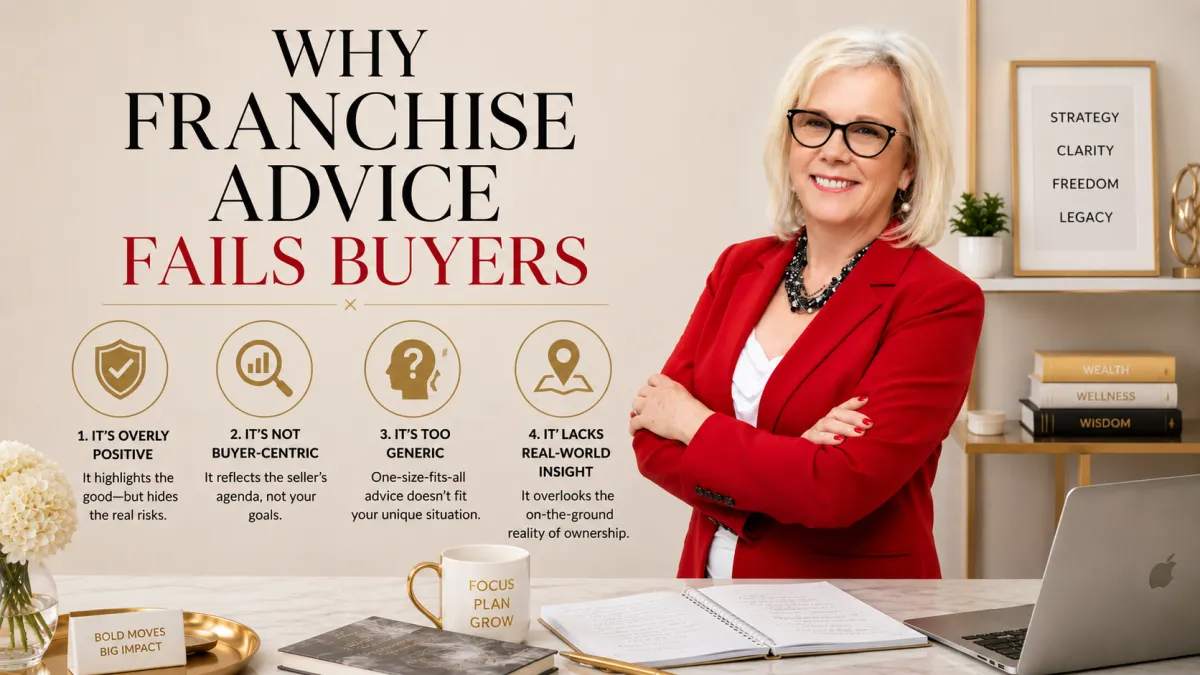
Why Franchise Advice Fails Buyers
How brokers push inventory over alignment—and what to do instead
Let me tell you something that might make a few people uncomfortable:
Most franchise advice you're getting is designed to benefit someone else—not you.
I'm not saying this to scare you. I'm saying it because after 40+ years in franchising—as an owner, consultant, trainer, and strategist—I've seen what happens when people trust the wrong guidance.
And it breaks my heart every single time.
The Problem With "Franchise Brokers"
Here's how it typically works:
You're curious about franchising. Maybe you took a quiz, downloaded a guide, or filled out a form somewhere online.
Within 24 hours, your phone rings.
It's a franchise broker. Friendly. Confident. Full of energy.
They ask a few surface-level questions:
"What's your budget?"
"What industries interest you?"
"How soon are you looking to get started?"
Then—boom—they start sending you franchise opportunities.
Sounds helpful, right?
Wrong.
Here's what's really happening behind the scenes:
Most franchise brokers don't get paid by you. They get paid by the franchisors—the companies selling the franchises.
And not all franchises pay the same commission.
So guess which ones they're most motivated to show you?
The ones that pay them the most.
Not the ones that fit your lifestyle.
Not the ones aligned with your financial goals.
Not the ones that match your strengths, values, or long-term vision.
The ones that fatten their commission check.
It's Inventory Management, Not Matchmaking
I've been in rooms with franchise brokers who literally refer to their clients as "leads" and franchise brands as "inventory."
Think about that for a second.
You're not a person with dreams, goals, and a family counting on you to make a smart decision.
You're inventory to be moved.
And the franchise? It's not a life-changing investment—it's a product they need to sell before the month closes.
That's not guidance. That's a sales funnel.
And it's why so many people end up in franchises that look great on paper but feel terrible in real life.
The Red Flags You Need to Watch For
Not all franchise consultants operate this way—but too many do.
Here are the warning signs that you're being pushed, not guided:
🚩 Red Flag #1: They lead with "hot opportunities"
If the first thing out of their mouth is "This franchise is blowing up right now," run.
Trends are not strategies. What's hot today might be saturated tomorrow.
Your business decision should be based on your goals—not someone else's hype.
🚩 Red Flag #2: They pressure you to move fast
"There are only 3 territories left in your area."
"If you don't sign by Friday, this opportunity is gone."
"Other candidates are looking at this right now."
Manufactured urgency is a sales tactic—not professional advice.
A good consultant wants you to take your time, do your due diligence, and feel 100% confident in your decision.
🚩 Red Flag #3: They only show you 2-3 brands
If a broker is only presenting a narrow set of options, ask yourself: Why?
Are those truly the best fits for me—or just the ones paying the highest commission?
You deserve to see a full range of possibilities that align with your unique situation.
🚩 Red Flag #4: They don't dig into your lifestyle goals
Franchising isn't just about making money. It's about creating the life you want.
Do you want to work in the business or oversee it from a distance?
Do you want a small team or a large operation?
Do you want flexibility to travel—or are you all-in on building an empire?
If your consultant isn't asking these questions, they're not doing their job.
🚩 Red Flag #5: They get defensive when you ask tough questions
"Who's paying you?"
"Why are you recommending this franchise over others?"
"What happens if this doesn't work out?"
If they dodge, deflect, or make you feel like you're being "difficult," that's a problem.
A trustworthy advisor welcomes your questions—because they have nothing to hide.
What Real Guidance Looks Like
I've spent decades in franchising, and I can tell you this:
The right franchise can change your life.
It can give you freedom, wealth, flexibility, and a legacy that outlives you.
But only if it's the right fit.
That's why my approach is different.
I don't work for franchisors. I work for you.
I'm not pushing inventory. I'm building a strategy around your life.
And I'm not interested in closing a deal this week. I'm interested in your success for the next 10 years.
The 3 Things Every Franchise Must Fit
Your life, your goals, your financial plan—and why all three matter more than the brand name
I'll never forget the call I got from Mark.
He'd just invested $250,000 into a fitness franchise. On paper, it was perfect—booming industry, recognizable brand, strong franchisee support.
There was just one problem:
Mark hated going to the gym.
He wasn't a fitness guy. He didn't love the culture. He didn't want to spend his days talking about meal prep and workout routines.
But the broker told him it was a "can't-miss opportunity." The numbers looked good. So he signed.
Six months later, Mark was miserable.
The business was doing fine—but he wasn't.
He dreaded walking in every morning. He resented the time it took away from his family. And he felt trapped in a business he'd bought his way into but couldn't sell his way out of.
That's what happens when you choose a franchise that doesn't fit.
And it's exactly why I've built my entire practice around one core principle:
A franchise is only as good as how well it fits your life, your goals, and your financial plan.
Not someone else's. Yours.
Let's break down what that really means.
Fit #1: Your Life
This is the one most people miss—and the one that matters most.
Because here's the truth: You can make money in a lot of different businesses. But if the business doesn't fit your lifestyle, the money won't matter.
You'll be rich and exhausted.
Successful and resentful.
Building something impressive that's slowly breaking you.
So before you fall in love with a franchise concept, ask yourself these questions:
Do I want to work IN the business or ON it?
Some franchises require you to be there every day—managing employees, serving customers, handling operations.
Others are designed to be semi-absentee or manager-run, where you oversee the business but don't need to be on-site full-time.
Neither is better. But one is definitely better for you.
If you love being in the trenches, don't buy a passive investment.
If you want freedom and flexibility, don't buy a business that demands 60 hours a week.
What does my ideal week actually look like?
Be honest.
Do you want to drop your kids off at school every morning?
Do you want to travel and run your business from your laptop?
Do you want to work evenings and weekends—or never again?
Your franchise should support the life you want—not hijack it.
Does this business energize me or drain me?
Mark's fitness franchise drained him because he didn't care about fitness.
But I've worked with clients who lit up talking about senior care, pet services, home improvement, and business coaching.
You don't have to be passionate about the industry—but you do need to be interested enough to show up with energy.
Because if you're not, your team will feel it. Your customers will feel it. And eventually, you'll feel it.
Fit #2: Your Goals
Here's where most people make a critical mistake:
They choose a franchise based on what it can do—without asking if it aligns with what they want to do.
"This franchise makes $500K a year!"
Okay—but do you want the kind of business that requires 15 employees and daily operational involvement to hit that number?
"This brand has 2,000 locations!"
Great—but are you trying to build a single, profitable location or a multi-unit empire?
Your goals matter. A lot.
Are you replacing income or building wealth?
If you're coming out of corporate and need to replace a six-figure salary, you need a franchise that can generate cash flow relatively quickly.
If you're already financially secure and looking to build long-term wealth, you might prioritize appreciation, resale value, and passive income over immediate cash flow.
These are two very different strategies—and they require different franchises.
Are you building a job, a business, or a legacy?
Some people want to own their job—work hard, make great money, and have control over their schedule.
Others want to build a business they can scale, systematize, and eventually step away from.
And some are building a legacy—something they can pass down to their kids or sell for a life-changing exit.
All three are valid. But you need to know which one you're building.
Because if you want a legacy and you buy a job, you're going to be frustrated.
And if you want a job and you buy a complex multi-unit operation, you're going to be overwhelmed.
What does success look like in 5 years? In 10?
Most people don't think this far ahead—and that's a mistake.
Because the franchise you choose today will shape your life for the next decade.
So ask yourself:
Do I want to own one location or ten?
Do I want to be hands-on or fully delegated?
Do I want to exit in 5 years or build something I run for 20?
The clearer you are on your long-term vision, the better decision you'll make today.
Fit #3: Your Financial Plan
Let's talk money.
Not just "How much does it cost?"—but "How does this investment fit into my overall financial picture?"
Because here's what I've learned after 40+ years in franchising:
It's not about having enough money to buy the franchise. It's about having enough money to run it—and still sleep at night.
What's your total investment—really?
Most people focus on the franchise fee.
But that's just the beginning.
You also need to factor in:
Build-out costs (if it's a physical location)
Equipment and inventory
Working capital (to cover expenses while you ramp up)
Marketing and grand opening costs
Your personal living expenses while the business gets profitable
I've seen too many people drain their savings to buy a franchise—and then panic when they realize they don't have enough runway to make it work.
Don't be that person.
What are your cash flow expectations?
Every franchise has a different ramp-up period.
Some are profitable in 6 months. Others take 18-24 months.
You need to know:
How long until the business is cash-flow positive?
How long until it's replacing your income?
How much will you need to invest (time and money) to get there?
And most importantly: Can you afford to wait?
If you need income now, don't invest in a franchise with a 2-year ramp-up—no matter how good the long-term projections look.
How does this fit into your overall wealth strategy?
A franchise isn't just a business—it's an asset.
And like any asset, it should fit into your broader financial plan.
Questions to consider:
Does this diversify your income or add risk?
How does this investment compare to other opportunities (real estate, stocks, another business)?
What's your exit strategy? Can you sell this business when you're ready?
How does this impact your retirement plan, your kids' college fund, your long-term security?
If your financial advisor, CPA, or spouse has serious concerns—listen.
You don't have to follow their advice blindly, but you do need to understand the risks and have a plan to manage them.
The Franchise That Fits Changes Everything
When you find a franchise that fits all three—your life, your goals, and your financial plan—everything clicks.
You wake up excited to work.
You feel confident in your decision.
You're building something that supports the life you actually want to live.
That's what I help you do.
Through my Freedom Franchise Blueprint, we don't start with a list of franchises.
We start with you.
Your lifestyle. Your goals. Your financial picture.
And then—and only then—do we start exploring franchise options that align with all three.
No pressure. No hype. No inventory pushing.
Just honest, strategic guidance to help you make the smartest decision of your life.
Ready to Find Your Fit?
If you're tired of generic advice and ready for a personalized approach, let's talk.
Take the Clarity Assessment – Find the franchise that fitswho you are.
Or book a free 20-minute clarity call and let's explore what's possible—no pressure, no pitch, just real conversation.
Because you don't need just any franchise.
You need the one that fits.
To your success,
Phyllis Pieri